
Section 1: Brand Storytelling in the Digital Marketing Context
Stories are important to digital marketing because they make a brands strategy something that audiences can identify and retell. Moin (2020) distinguishes strategic stories as those that declare purpose, mission and values, from tactical stories told by the company, its customers or its users. The strategic layer fixes identity, and the tactical layer carries it into each channel. Sinek’s (2009) Golden Circle makes a similar claim, since audiences respond first to why a brand exists. Hollebeek and Macky (2019) add that digital content marketing aims to build engagement, trust and relationships before sales, and that brand equity grows from those outcomes. Stories are how content earns that value over time.
The mechanism is partly cognitive. Kahneman (2011) distinguishes fast, intuitive System 1 processing from slower, deliberate System 2 evaluation. Emotional stories speak to System 1 and help a brand become memorable before a buyer starts comparing options. Narrative transportation explains why: absorbed audiences shift their attitudes and intentions towards the story (van Laer et al., 2014). Digital conditions change the size of this effect. In a meta-analysis of 64 articles, van Laer et al. (2019) found transportation was stronger for commercial stories, for user-generated stories and when one person receives the story alone, as on a phone feed. Dessart and Pitardi (2019) show that plot, characters and believability trigger cognitive, emotional and then behavioural engagement, so engagement builds through the story.
These claims need limits. Teaching material often presents oxytocin as a trust hormone, but a critical review found the link between oxytocin and human trust has not replicated well (Nave et al., 2015). Neuroscience language can lend storytelling authority it has not earned. Stories are also not always more effective than facts. Dessart (2018) found that storytelling video ads with animal characters reduced character identification and lowered brand attitudes. Hamelin et al. (2020) report a further trade-off: affective stories change attitudes faster, but cognitive stories are retained longer. I read these findings as making storytelling conditional. Its value depends on the response a brand needs, the journey stage and whether the story can be checked.
RACE brings an operational set of conditional stories. Emotional stories lend themselves to Reach, informative ones make suitable Act and Convert stories, and participatory stories enable Engage (Chaffey, 2025). The take stock survey of 1,200 marketers from HubSpot (2025) reports more investment into brand-led and values based stories, with short-form video as the leading format; and since HubSpot sell marketing software, I interpret this as a signal of practice, not of effect. AI adds a new trust dimension. The Chartered Institute of Marketing (2025) presents AI as a pioneering new creative partner, but requiring human control, while for Baek et al (2024), revealing AI produced content reduced ad attitudes by reducing ad credibility. Trust so has to be embedded into AI-supported stories from the outset.
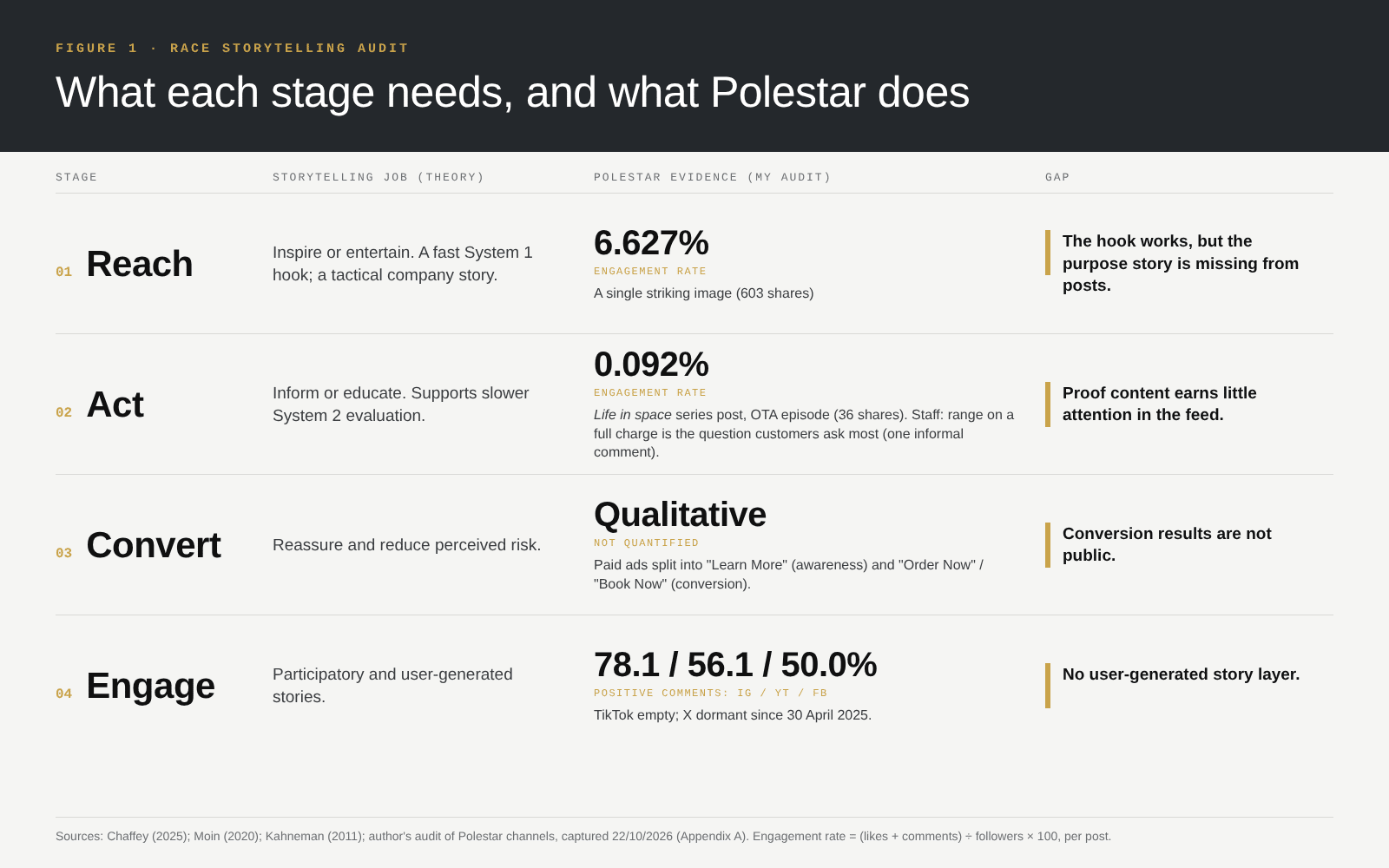
Applied to Polestar, my Section 2 audit shows strong System 1 content and a weaker strategic story. On relevance, Polestar’s purpose of improving society appears in profile bios rather than in posts (Appendix A). Coherence is strained because the climate-neutral car target moved from 2030 to 2035 (Polestar Automotive Holding UK PLC, 2026b), while a 2021 page still promises 2030 (Polestar, 2021). At Reach, a striking single image achieved a 6.627% engagement rate with 603 shares, while a post from the Life in space series reached 0.092% with 36 shares (Figure 1). Positive sentiment falls from 78.1% of opinion-bearing comments on Instagram to 50.0% on Facebook (Table 2.2). Participation is the largest gap, because I found no user-generated story layer. At the Battersea showroom, one staff member told me informally that range on a full charge is the question customers ask most. This is a single unrecorded comment, but it points to System 2 evaluation at the Act stage. Polestar needs an emotional hook followed by checkable evidence, which Sections 3 and 4 develop.