Section 2: Brand Storytelling & Content Audit
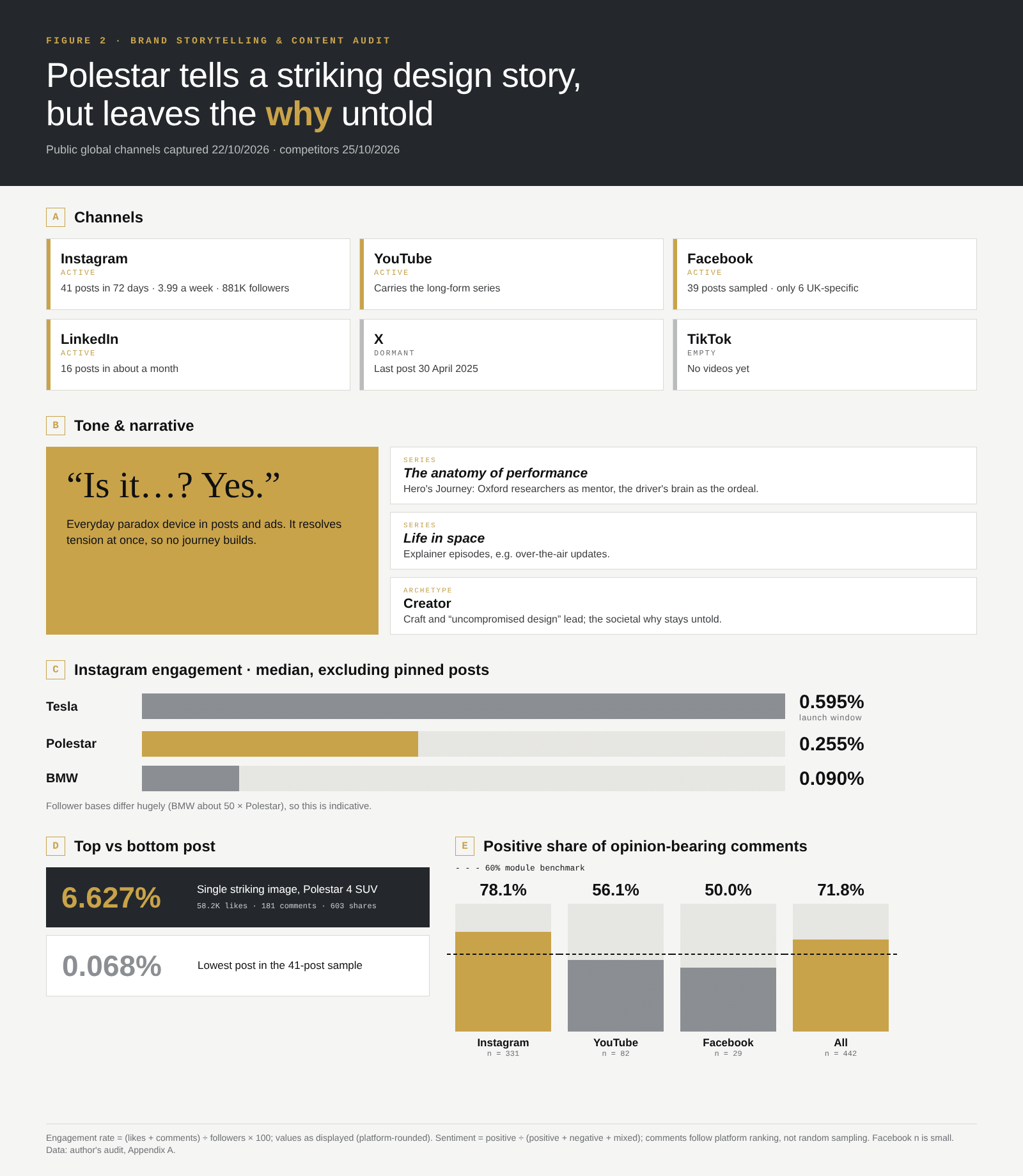
Purpose and coherence. Polestar’s why is clear via the Golden Circle (Sinek, 2009), an electric performance brand “set to improve the society we live in” (Polestar, n.d.-a). Its how is design, with the strategy of entering “fast-growing, high-value segments” (Polestar Automotive Holding UK PLC 2026a Guidance section) (Polestar Automotive Holding UK PLC, 2026a, Guidance section). But the why is in bios, not posts. And absence of coherence is another one of Moin (2020) laws of branding. The 2030 call for a climate-neutral car a Polestar 0 has been postponed to 2035 (Polestar Automotive Holding UK PLC, 2026b, p. 33), while the promise of 2030 in 2021 is still kicking (Polestar, 2021).
Narrative structure. Polestar’s everyday device is a paradox, “Is it…? Yes.”, used in posts and ads; it resolves tension at once, so no journey builds. The anatomy of performance series instead follows the Hero’s Journey (Vogler, 2007), with Oxford researchers as mentor and the driver’s brain as the ordeal, inviting narrative transportation (van Laer et al., 2014). The dominant archetype is the Creator (Mark & Pearson, 2001): craft and “uncompromised design” (Polestar, n.d.-a) lead, but they voice the how and leave the societal why untold.
Formats and channels. In paid–owned–earned (Forrester, 2009) and RACE (Chaffey, 2025) terms, owned Instagram and YouTube carry the story; paid ads split into “Learn More” awareness and “Order Now” or “Book Now” conversion. X has been dormant since 30 April 2025, TikTok is empty, and only six of 39 sampled Facebook posts are UK-specific, mostly events (Appendix A).
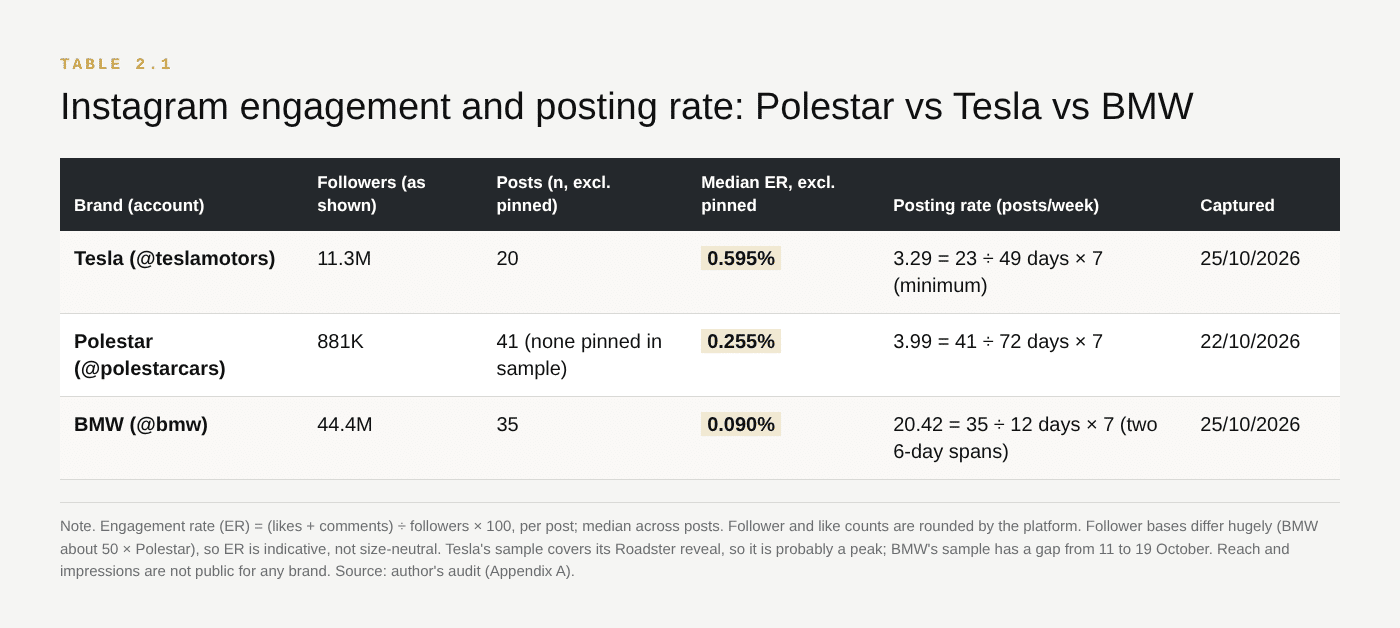
Performance. Excluding pinned posts, Polestar’s median Instagram engagement of 0.255% beats BMW’s 0.090% but trails Tesla’s launch-window 0.595% (Table 2.1), although follower bases differ fiftyfold. Striking single images reach 6.627% with 603 shares; a narrative series post manages 0.092% and 36 shares, as Berger and Milkman (2012) would predict. Yet Hamelin et al. (2020) found affective stories shift attitudes faster but cognitive ones are retained longer, so explainer content may be under-rewarded rather than failing. Unpublished paid reach may distort these comparisons.
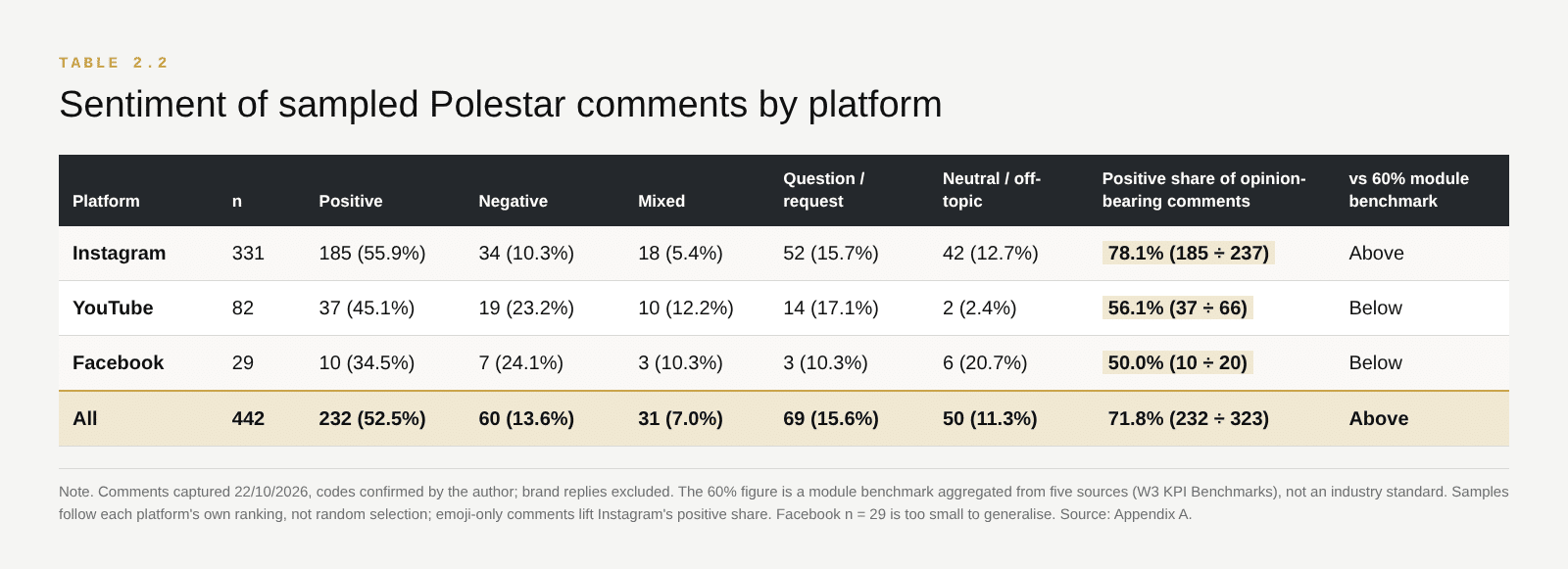
Strengths and gaps. Comments praise the design, but recurring complaints about software, aftersales and availability reveal a gap between the performance story and ownership, and a cluster likening Polestar 5 to a Kia K5 threatens distinctiveness (Appendix A). Against a 60% positive module benchmark, opinion-bearing comments are 78.1% positive on Instagram but only 56.1% on YouTube and 50.0% on Facebook (Table 2.2).
Ethics. Acceleration footage shows the box, by including a closed-road disclaimer, but discreetly escaping the box, by tampering with the 2035 slip, is as much greenhushing (Khan et al., 2026) as greenwashing (Delmas & Burbano, 2011), and green-honest UK guidelines insist green claims must be based generally life cycle (Competition and Markets Authority, 2021). BMW stages “AI content” in some posts; transparency, which Polestar should match. I address this here in section 4, by explaining why Polestar’s untold why to UK readers with an emotional intro and verifiable evidence.