Section 4: Digital Storyboard & Original Content
Concept and story arc. “The Full Story” responds to the gap my audit found between Polestar’s design story and the questions buyers bring to it (Section 2). It serves Polestar’s strategy by telling the story of a brand “determined to improve the society we live in” (Polestar, n.d.-a), keeping design as the differentiator in “fast-growing, high-value segments” (Polestar Automotive Holding UK PLC, 2026a, Guidance section) and ending at a test-drive booking. I built the campaign as a sequence of question, answer, proof and next step, and each piece moves Sam one RACE stage forward (Chaffey, 2025). The video opens on craft to win fast, intuitive attention, then hands over to material he can check slowly (Kahneman, 2011). Hamelin et al. (2020) found that affective stories shift attitudes faster while cognitive ones are retained longer, so I put the affective material first and placed the cognitive material in formats that can hold it. The pieces share one spine. The video sends viewers to the blog, and the email repeats the same range figure and source, so a fact checked in one place matches the others.
My class plan relied on filming an owner’s first year. I had no owner to film, and inventing one would break the trust the campaign is meant to build. I rebuilt the opening piece around my own visit and the question the Battersea staff member said customers ask most (Appendix A).
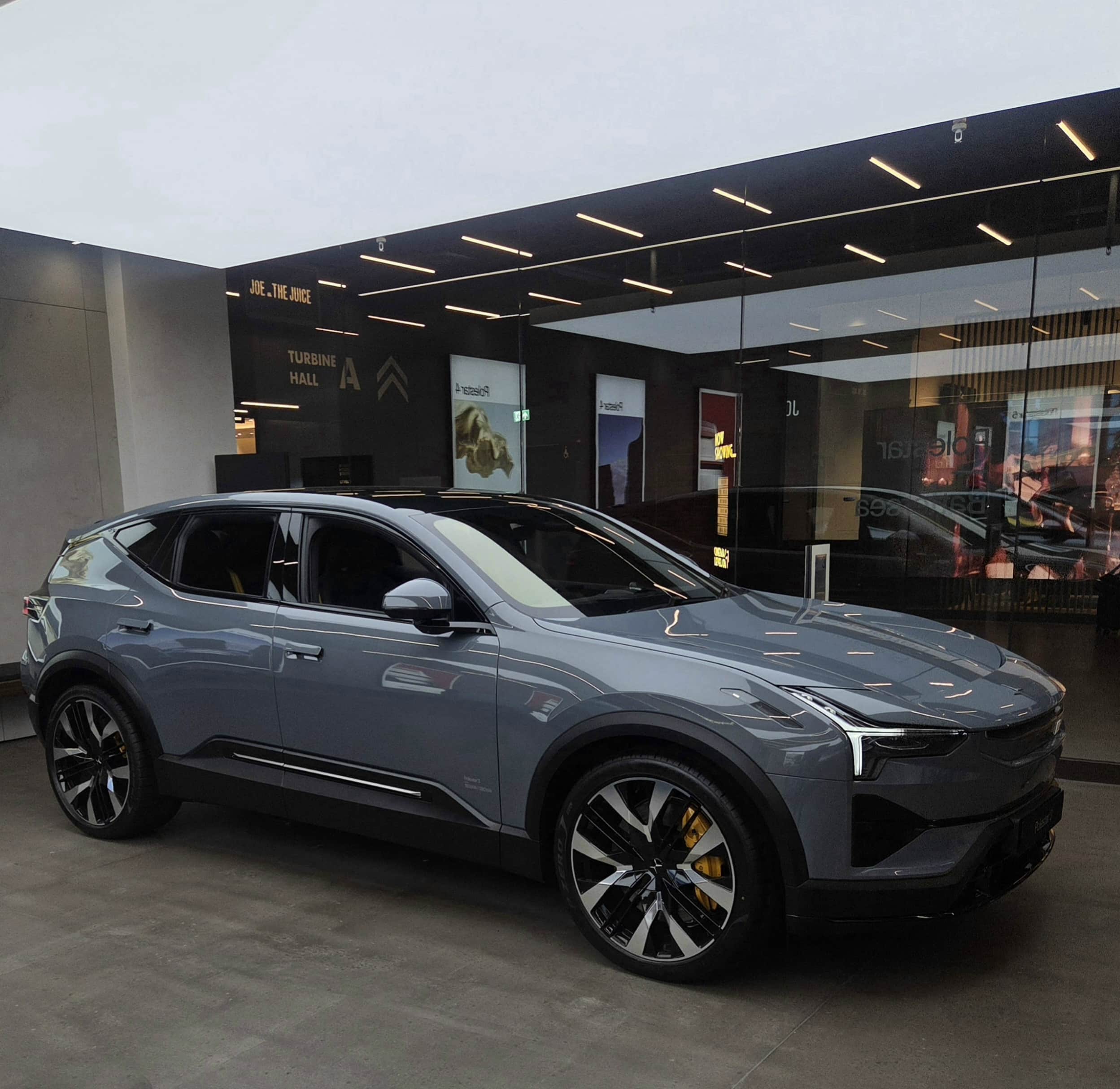
All three pieces share one visual system: my own showroom images, a muted cool grade, one sans-serif typeface and a single gold accent sampled from the calipers. The gold links the craft hook to the buttons that ask for action, so the detail Sam notices first becomes his cue to act. My footage is the campaign’s main point of difference, and a generated image would undercut the claim that I was there.
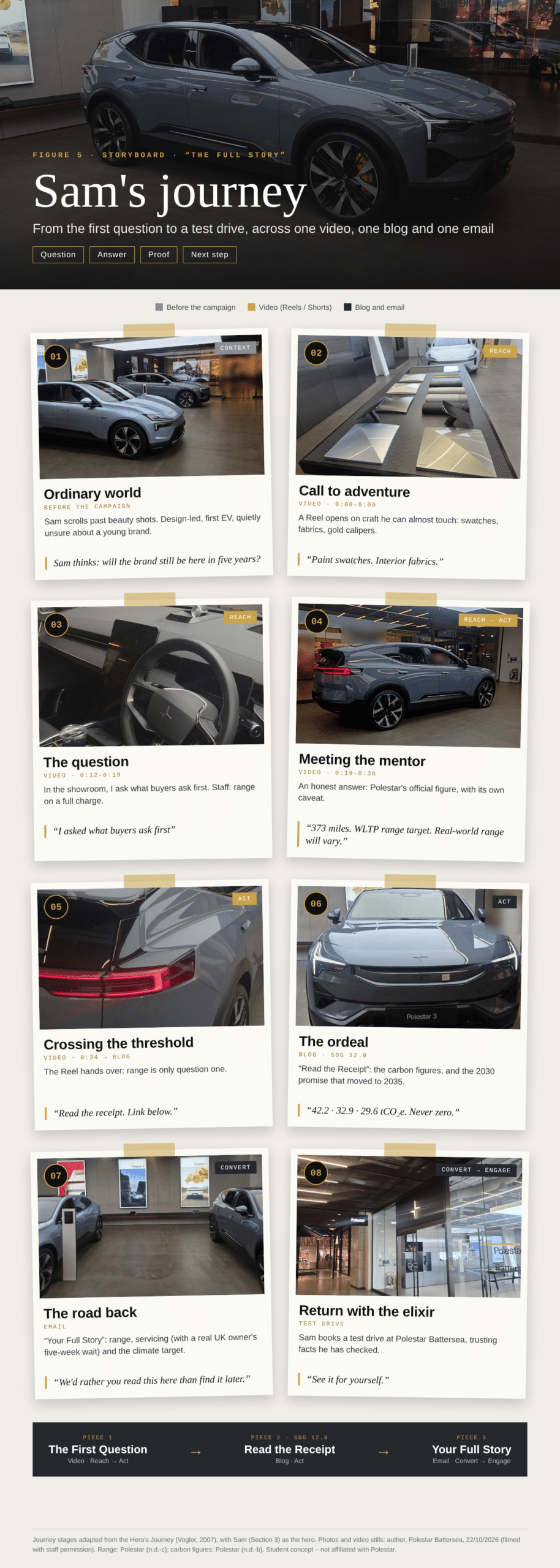
Piece 1: “The First Question” (vertical video, Figure 6).
Objective: stop a design-led prospect, then give him the figure he looks for first.
Strategic rationale: My footage of the material table and the gold calipers makes up the hook. Range material is provided, with Polestar’s own ‘Life in space: Range’ film (Appendix A), and a warning about a ‘sea of sameness’ in AI-generated content from W5 (Coventry University London, n.d.-a). The hand-held footage of a showroom in London is uncopyable; it builds on the light content in Section 2, the UK’s ‘thin’ content, from Polestar’s own ‘Is it? Yes. device keeps the voice on-brand. The figure is Polestar’s WLTP range target for the Polestar 3 Performance, 373 miles, with the page’s caveat that real-world range varies (Polestar, n.d.-c). I chose this version because the showroom price stand confirmed it was the car I filmed (Appendix A), and its figure is the lowest of the three. I excluded the 230-mile dashboard reading because it is not a published figure. Range anxiety is debated. Kershaw et al. (2018) found that anxiety diminishes with experience, though Noel et al. (2019) see range anxiety as a rhetorical device against change. Both readings favour a calm, sourced answer and an invitation to try the car over reassurance alone.
RACE stage: Reach, moving to Act.
Piece 2: “Read the Receipt” (blog, Figure 7), linked to SDG 12.8.
Objective: give readers Polestar’s carbon figures and the revised target in one place, with page references.
Strategic rationale: SDG target 12.8 asks that people everywhere have “the relevant information and awareness for sustainable development” (United Nations, n.d.). The link is real but partial, because its indicator measures education policy, so a brand blog serves the target’s aim, not its measurement. The blog states the revision openly. The 2021 plan aimed for a climate-neutral car by 2030 (Polestar, 2021), and the 2025 report moves that target to 2035 (Polestar Automotive Holding UK PLC, 2026b, p. 33). Chen and Chang (2013) show that greenwash lowers green trust partly through confusion and perceived risk, and an unexplained moved target invites both. Hernandez et al. (2023) found that two-sided advertising raised credibility and purchase intention among highly sceptical consumers without reducing trust among others, and Sam fits that sceptical profile (Section 3). The blog uses whole-life-cycle figures and avoids “zero emission” language, in line with UK guidance (Committee of Advertising Practice, 2024; Competition and Markets Authority, 2021). Openness may read as weakness. I accept that risk, because the 2030 promise is still public and a reader who finds it alone may feel misled.
RACE stage: Act.
Piece 3: “Your Full Story” (email, Figure 8).
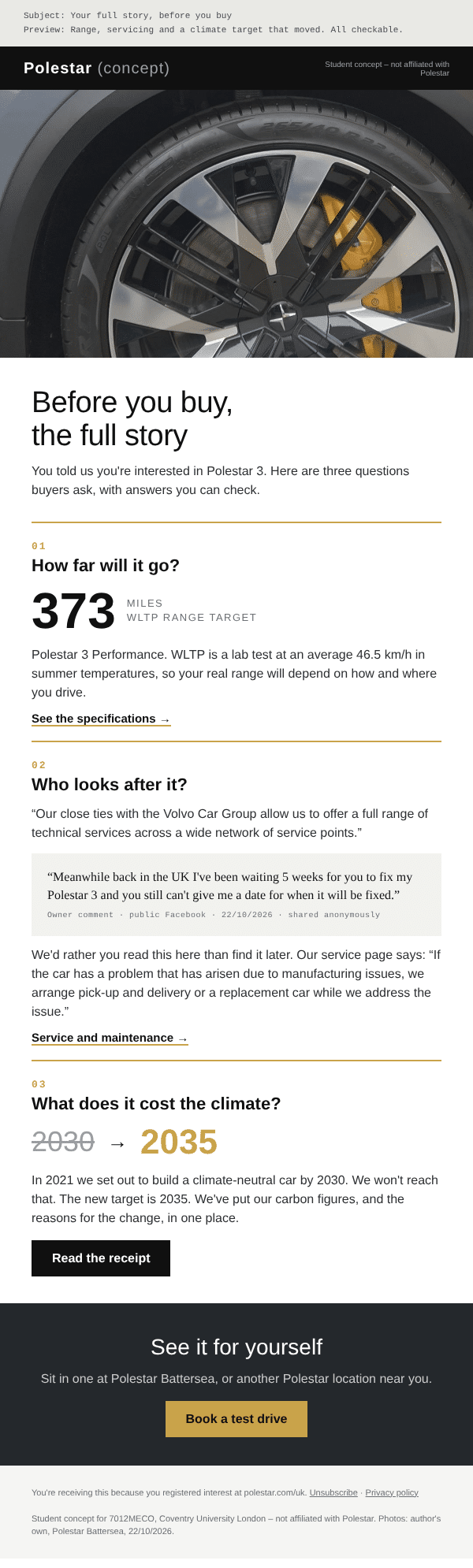
Objective: turn registered interest into a test-drive booking.
Strategic rationale: The email answers three questions before purchase. It repeats the range figure, explains servicing through Polestar’s ties with Volvo Car Group (Polestar, n.d.-d) and links to the blog. Under the servicing answer sits one anonymised owner comment about a five-week UK repair wait. Including this critical comment is deliberate. Section 3 showed that Sam’s doubt concerns life after purchase, and Hollebeek and Macky (2019) place trust before sales in content marketing. Hiding a complaint Sam can already read under Polestar’s posts would cost more trust than it saves.
RACE stage: Convert, then Engage.
Channels and audience fit. Reels and Shorts carry the video because Polestar’s audience sits mainly on Instagram and YouTube (Section 2), and Sam meets the brand on his phone. I left out X and TikTok. Reviving a dormant account for one campaign would look opportunistic, and I have no evidence that Sam researches cars on TikTok. The blog lives on an owned site so every figure links to its source.
Ethics and inclusivity. I tested each piece against the TARES test (Baker & Martinson, 2001; Appendix D). Truthfulness drives the main choices: one named version, one official figure with its caveat, and the revised target in the blog’s opening section. For authenticity, every piece carries “Student concept – not affiliated with Polestar”. Owner voices appear only as public comments, quoted verbatim, anonymised and labelled with platform and date. I rejected composite “customers” because a composite is an invention. Commenters did not agree to appear in a campaign, so I removed names and kept quotes short. For accessibility, the video has burned-in captions and a transcript, images carry alt text, and the email works in plain text. Blurring passers-by protects people who did not agree to be filmed.
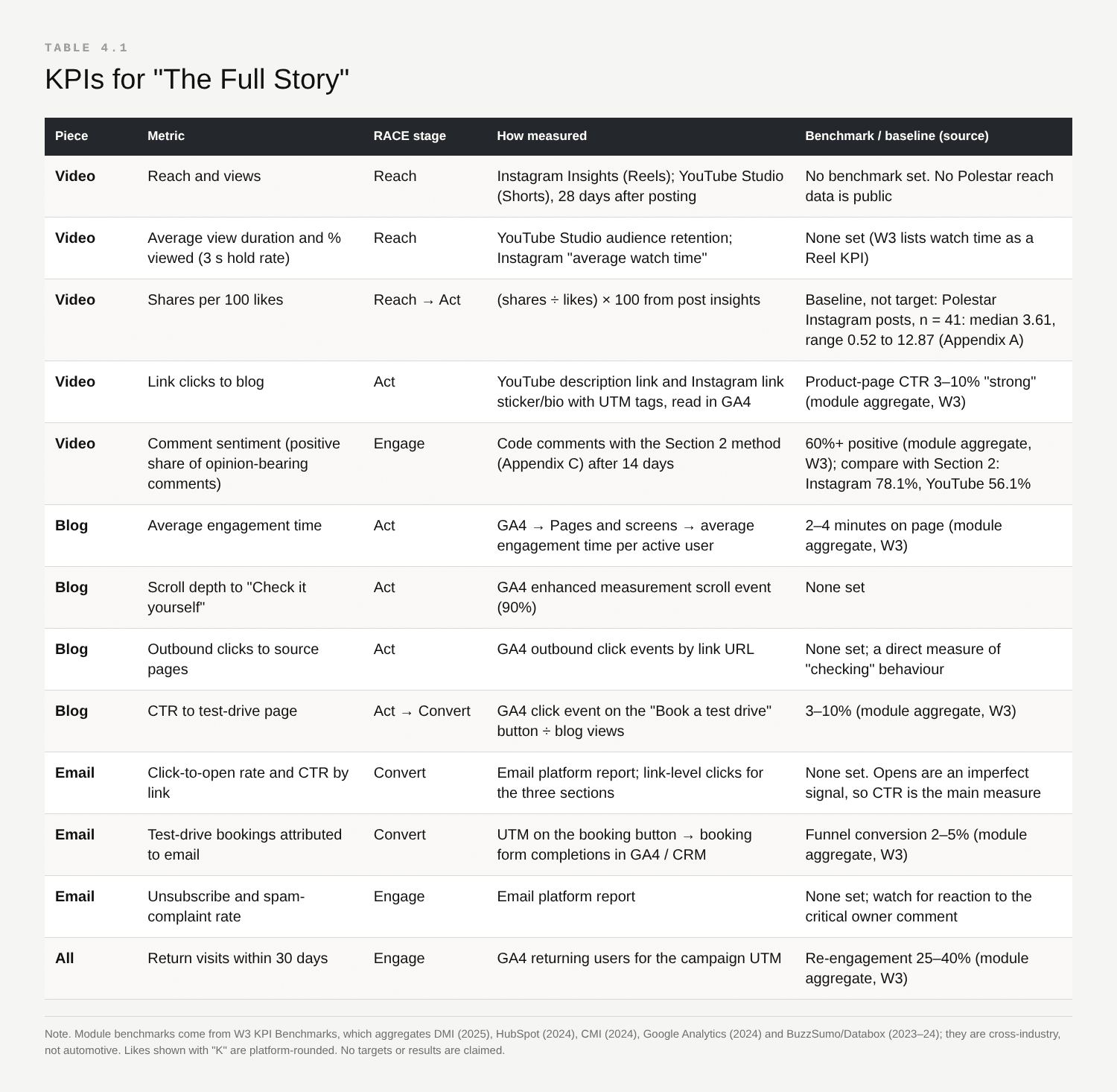
Measurement. Table 4.1 sets out each KPI, its RACE stage and its data source. I set no numerical targets because I have no Polestar baseline for reach, clicks or bookings. Module reference points, such as 60% positive sentiment or two to four minutes on page (Coventry University London, n.d.-c), serve as comparisons only, since they aggregate cross-industry sources. Video comment sentiment can be compared directly with my Section 2 baseline, which makes it the clearest early test of whether openness builds trust. Bookings also respond to price offers and season, so I would read the KPIs together rather than credit any single result to the campaign’s honesty.