Section 5: Ethics, Global Context & Strategic Leadership Reflection
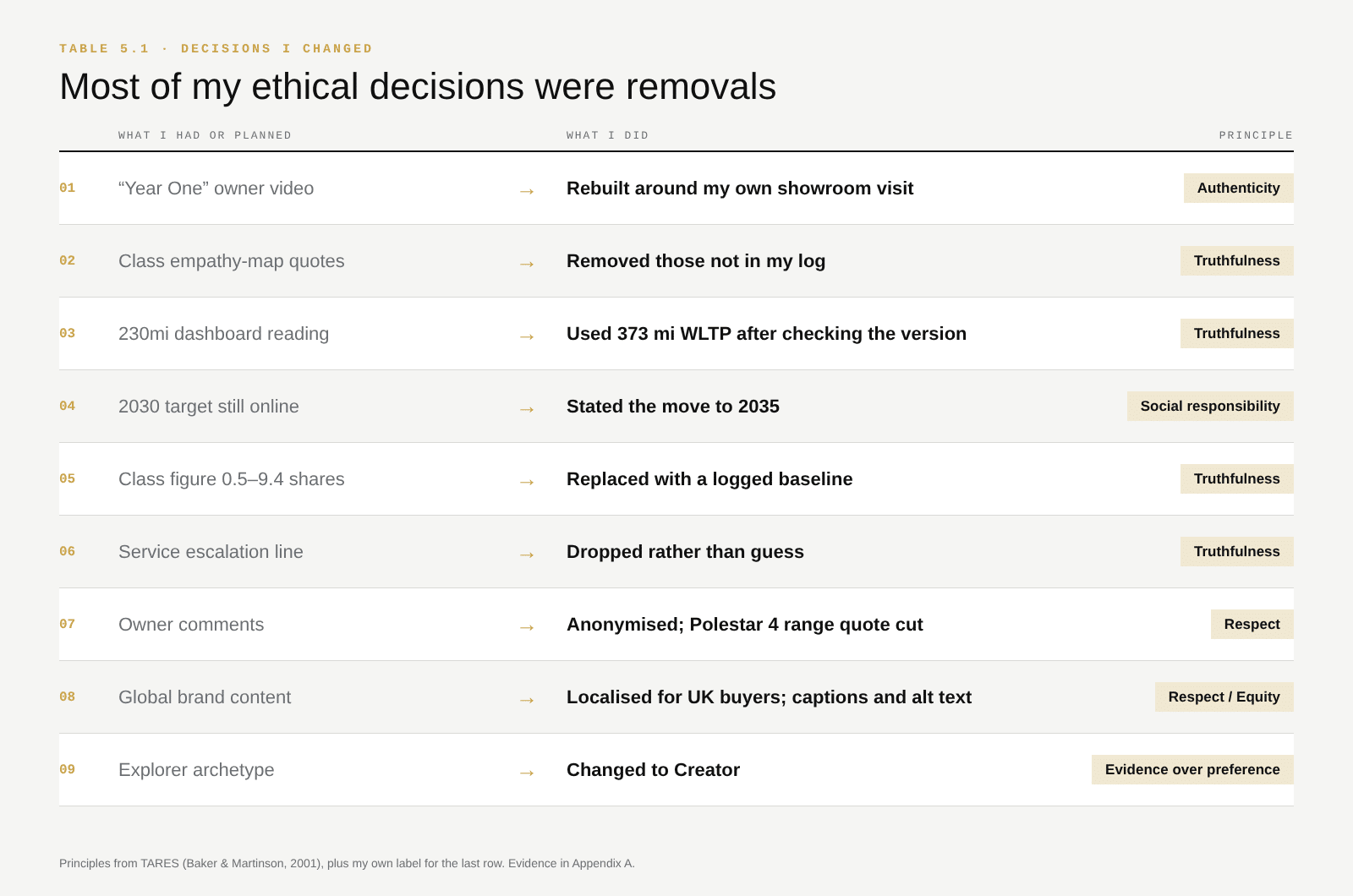
Most of my ethical decisions were removals (Table 5.1). I dropped the planned “Year One” owner video because I had no owner, and cut every class empathy-map quote I could not trace to my log. I excluded the 230-mile dashboard reading and checked the version on the showroom price stand before using Polestar’s 373-mile figure. The TARES test makes truthfulness and authenticity conditions of ethical persuasion (Baker & Martinson, 2001), and each cut applied them. Williams et al. (2017) note that composite accounts can protect people in research, but in a campaign a composite customer would pass as real, so I treated it as fabrication. I used only my own footage and labelled every piece as a student concept.
Quoting owners was harder. In a survey of 564 UK Twitter users, just under 80% expected to be asked before their posts were published, over 90% expected anonymity, and concern was higher for commercial than university use (Williams et al., 2017). I anonymised every comment. Yet my email reuses a stranger’s complaint without consent. Anonymity reduces the harm, but quoted text stays searchable. A live campaign would need the owner’s permission. For my KPIs, the Week 3 lecture, drawing on Zuboff (2019), describes surveillance capitalism as collecting more behavioural data than a service needs (Coventry University London, n.d.-e). I limited tracking to aggregate GA4 events, UTM tags and an opt-in email list, following the data-minimisation principle taught in Week 4 (Coventry University London, n.d.-b).
Polestar is a global brand, so its story needs local work. Some commenters reduce it to “so Chinese”, while a purely Scandinavian story would be another single story (Adichie, 2009). Section 3 set out the fuller picture of a Gothenburg base, Volvo aftersales and Geely-linked ownership. UK-only Facebook posts it was 39 posts in total, but only six (Section 2) were from the UK so I adapted the campaign using footage shot in Battersea, from an UK owner, and a claim checked against UK guidance (Committee of Advertising Practice, 2024; Competition and Markets Authority, 2021). The UK’s weak uncertainty avoidance (The Culture Factor Group, n.d.) and Meyer’s task-based trust (2014, as cited in Coventry University London, n.d.-b) made proof of delivery more important than reassurance. Captions, alt text and a plain-text email serve people who watch without sound or use screen readers.
“The Full Story” supports Polestar’s goals of design-led differentiation and test-drive bookings, but it also challenges the brand. Stating the delay from 2030 to 2035 and showing a five-week UK repair wait goes against the quiet handling my audit found. Khan et al. (2026) link that kind of greenhushing to lower trust. As a content leader rather than a producer (Coventry University London, n.d.-d), I would have to manage the tension between profit and purpose and persuade colleagues that openness protects trust (Chen & Chang, 2013), even if it costs some sales. Evidence changed my view of the archetype too. My class work called Polestar an Explorer, but the posts I audited pointed to the Creator. I enjoyed visiting the Battersea showroom, and I learned a lot from it.