Telling the Full Story: Brand Storytelling and Content Marketing for Polestar
Introduction
This portfolio looks at how Polestar, an electric performance car brand, tells its story online and how that story could earn more trust from UK buyers. Section 1 explains why storytelling matters to digital marketing and where its claims need limits. Section 2 audits Polestar’s current content and how it performs. Section 3 profiles the audience I chose, design-led Londoners buying their first electric car. Section 4, the centrepiece, presents “The Full Story”, a three-piece campaign with its rationale and KPIs. In Section 5 reflected on the ethical and leadership choices behind it.
Section 1: Brand Storytelling in the Digital Marketing Context
Stories are important to digital marketing because they make a brands strategy something that audiences can identify and retell. Moin (2020) distinguishes strategic stories as those that declare purpose, mission and values, from tactical stories told by the company, its customers or its users. The strategic layer fixes identity, and the tactical layer carries it into each channel. Sinek’s (2009) Golden Circle makes a similar claim, since audiences respond first to why a brand exists. Hollebeek and Macky (2019) add that digital content marketing aims to build engagement, trust and relationships before sales, and that brand equity grows from those outcomes. Stories are how content earns that value over time.
The mechanism is partly cognitive. Kahneman (2011) distinguishes fast, intuitive System 1 processing from slower, deliberate System 2 evaluation. Emotional stories speak to System 1 and help a brand become memorable before a buyer starts comparing options. Narrative transportation explains why: absorbed audiences shift their attitudes and intentions towards the story (van Laer et al., 2014). Digital conditions change the size of this effect. In a meta-analysis of 64 articles, van Laer et al. (2019) found transportation was stronger for commercial stories, for user-generated stories and when one person receives the story alone, as on a phone feed. Dessart and Pitardi (2019) show that plot, characters and believability trigger cognitive, emotional and then behavioural engagement, so engagement builds through the story.
These claims need limits. Teaching material often presents oxytocin as a trust hormone, but a critical review found the link between oxytocin and human trust has not replicated well (Nave et al., 2015). Neuroscience language can lend storytelling authority it has not earned. Stories are also not always more effective than facts. Dessart (2018) found that storytelling video ads with animal characters reduced character identification and lowered brand attitudes. Hamelin et al. (2020) report a further trade-off: affective stories change attitudes faster, but cognitive stories are retained longer. I read these findings as making storytelling conditional. Its value depends on the response a brand needs, the journey stage and whether the story can be checked.
RACE brings an operational set of conditional stories. Emotional stories lend themselves to Reach, informative ones make suitable Act and Convert stories, and participatory stories enable Engage (Chaffey, 2025). The take stock survey of 1,200 marketers from HubSpot (2025) reports more investment into brand-led and values based stories, with short-form video as the leading format; and since HubSpot sell marketing software, I interpret this as a signal of practice, not of effect. AI adds a new trust dimension. The Chartered Institute of Marketing (2025) presents AI as a pioneering new creative partner, but requiring human control, while for Baek et al (2024), revealing AI produced content reduced ad attitudes by reducing ad credibility. Trust so has to be embedded into AI-supported stories from the outset.
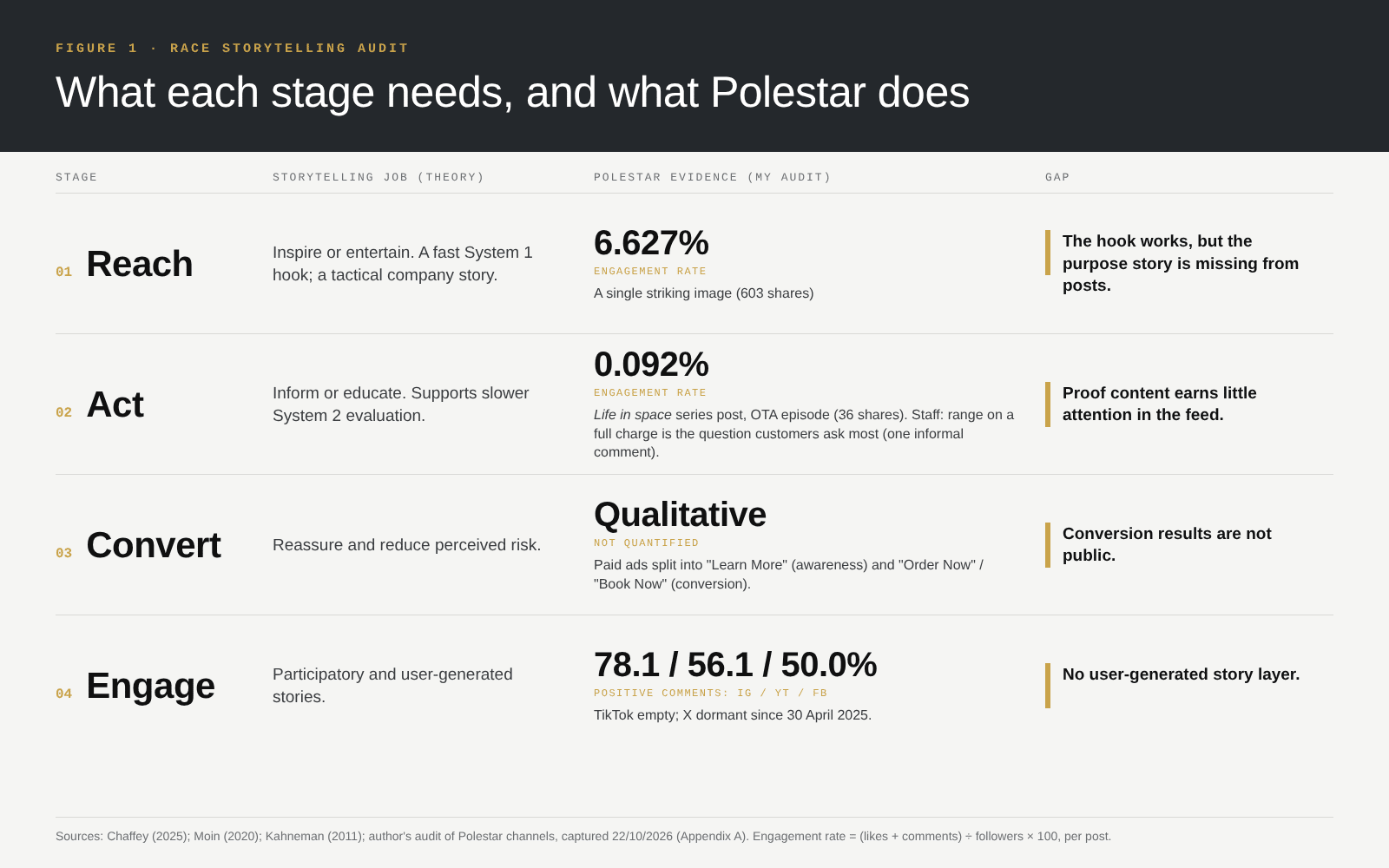
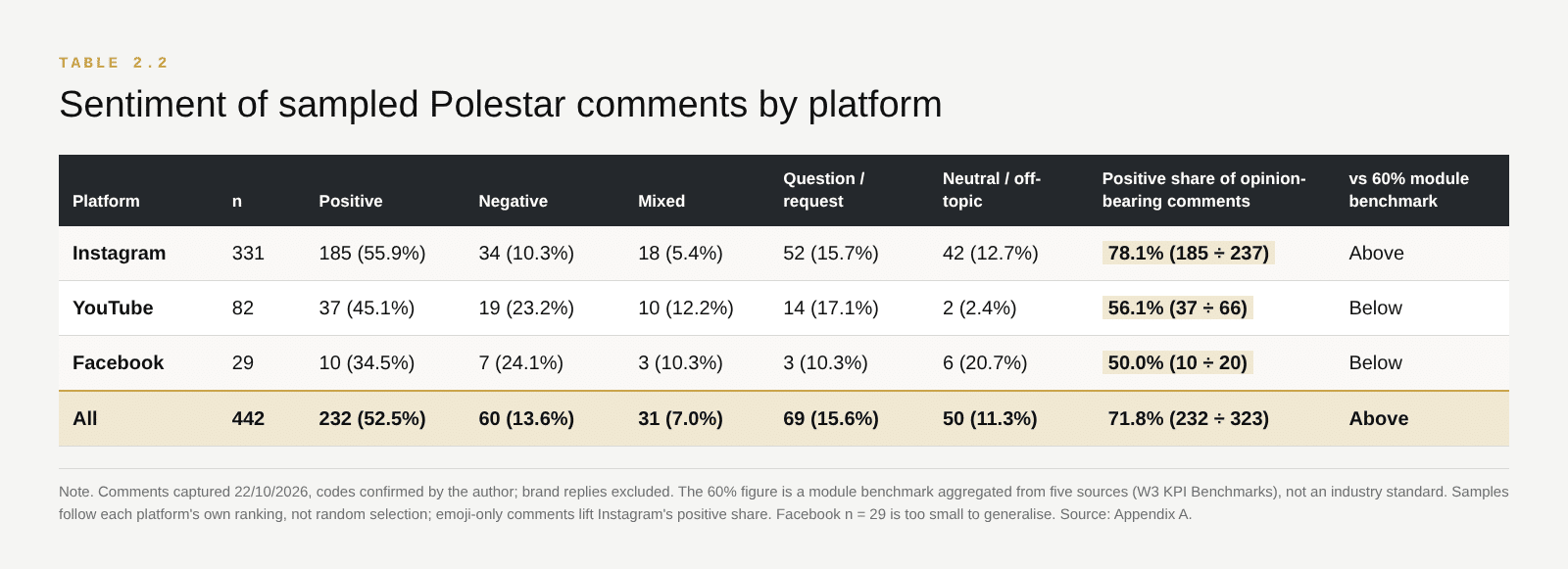
Applied to Polestar, my Section 2 audit shows strong System 1 content and a weaker strategic story. On relevance, Polestar’s purpose of improving society appears in profile bios rather than in posts (Appendix A). Coherence is strained because the climate-neutral car target moved from 2030 to 2035 (Polestar Automotive Holding UK PLC, 2026b), while a 2021 page still promises 2030 (Polestar, 2021). At Reach, a striking single image achieved a 6.627% engagement rate with 603 shares, while a post from the Life in space series reached 0.092% with 36 shares (Figure 1). Positive sentiment falls from 78.1% of opinion-bearing comments on Instagram to 50.0% on Facebook (Table 2.2). Participation is the largest gap, because I found no user-generated story layer. At the Battersea showroom, one staff member told me informally that range on a full charge is the question customers ask most. This is a single unrecorded comment, but it points to System 2 evaluation at the Act stage. Polestar needs an emotional hook followed by checkable evidence, which Sections 3 and 4 develop.
Section 2: Brand Storytelling & Content Audit
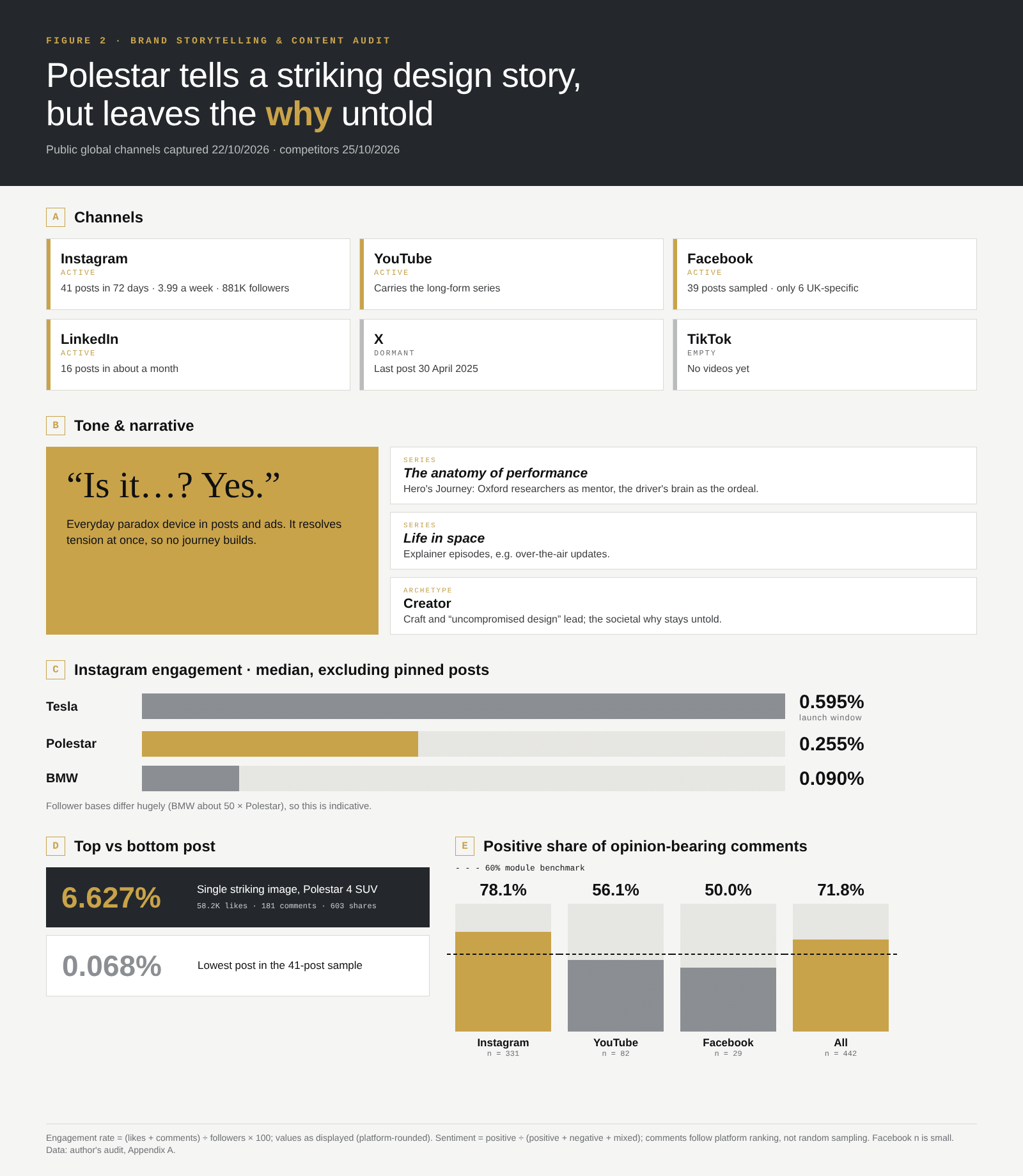
Purpose and coherence. Polestar’s why is clear via the Golden Circle (Sinek, 2009), an electric performance brand “set to improve the society we live in” (Polestar, n.d.-a). Its how is design, with the strategy of entering “fast-growing, high-value segments” (Polestar Automotive Holding UK PLC 2026a Guidance section) (Polestar Automotive Holding UK PLC, 2026a, Guidance section). But the why is in bios, not posts. And absence of coherence is another one of Moin (2020) laws of branding. The 2030 call for a climate-neutral car a Polestar 0 has been postponed to 2035 (Polestar Automotive Holding UK PLC, 2026b, p. 33), while the promise of 2030 in 2021 is still kicking (Polestar, 2021).
Narrative structure. Polestar’s everyday device is a paradox, “Is it…? Yes.”, used in posts and ads; it resolves tension at once, so no journey builds. The anatomy of performance series instead follows the Hero’s Journey (Vogler, 2007), with Oxford researchers as mentor and the driver’s brain as the ordeal, inviting narrative transportation (van Laer et al., 2014). The dominant archetype is the Creator (Mark & Pearson, 2001): craft and “uncompromised design” (Polestar, n.d.-a) lead, but they voice the how and leave the societal why untold.
Formats and channels. In paid–owned–earned (Forrester, 2009) and RACE (Chaffey, 2025) terms, owned Instagram and YouTube carry the story; paid ads split into “Learn More” awareness and “Order Now” or “Book Now” conversion. X has been dormant since 30 April 2025, TikTok is empty, and only six of 39 sampled Facebook posts are UK-specific, mostly events (Appendix A).
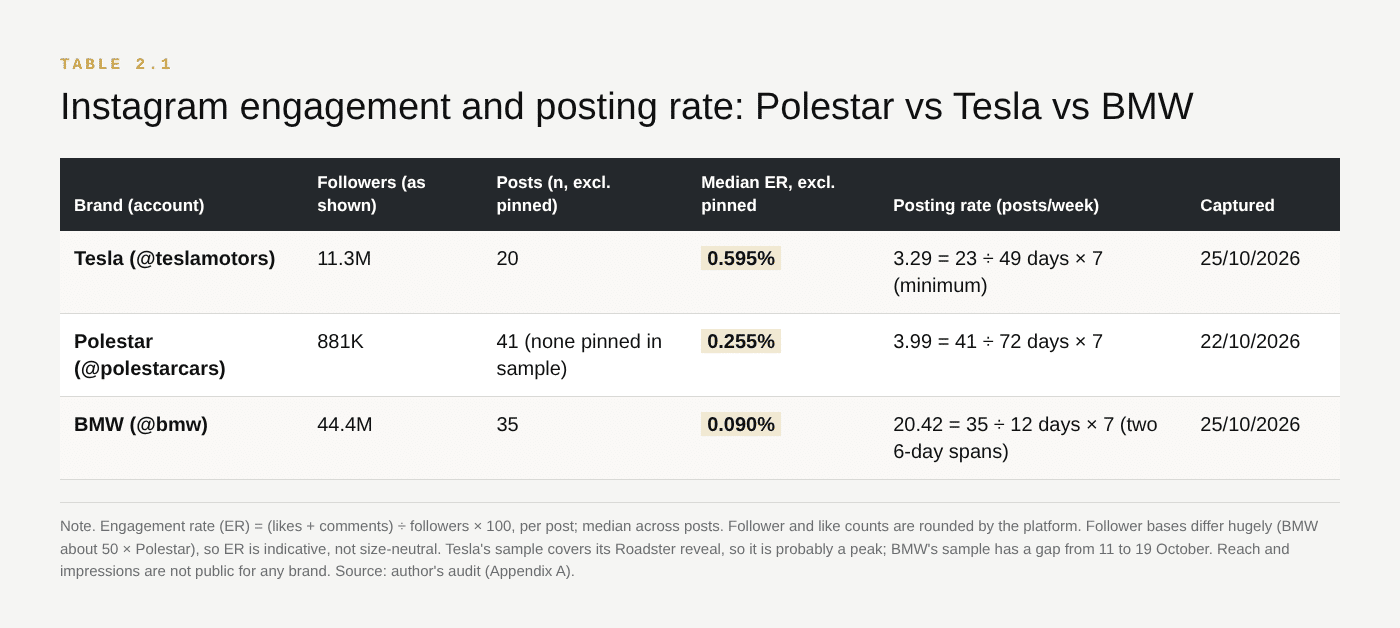
Performance. Excluding pinned posts, Polestar’s median Instagram engagement of 0.255% beats BMW’s 0.090% but trails Tesla’s launch-window 0.595% (Table 2.1), although follower bases differ fiftyfold. Striking single images reach 6.627% with 603 shares; a narrative series post manages 0.092% and 36 shares, as Berger and Milkman (2012) would predict. Yet Hamelin et al. (2020) found affective stories shift attitudes faster but cognitive ones are retained longer, so explainer content may be under-rewarded rather than failing. Unpublished paid reach may distort these comparisons.
Strengths and gaps. Comments praise the design, but recurring complaints about software, aftersales and availability reveal a gap between the performance story and ownership, and a cluster likening Polestar 5 to a Kia K5 threatens distinctiveness (Appendix A). Against a 60% positive module benchmark, opinion-bearing comments are 78.1% positive on Instagram but only 56.1% on YouTube and 50.0% on Facebook (Table 2.2).
Ethics. Acceleration footage shows the box, by including a closed-road disclaimer, but discreetly escaping the box, by tampering with the 2035 slip, is as much greenhushing (Khan et al., 2026) as greenwashing (Delmas & Burbano, 2011), and green-honest UK guidelines insist green claims must be based generally life cycle (Competition and Markets Authority, 2021). BMW stages “AI content” in some posts; transparency, which Polestar should match. I address this here in section 4, by explaining why Polestar’s untold why to UK readers with an emotional intro and verifiable evidence.
Section 3: Target Audience & Insight Summary
I chose design-led Londoners buying their first electric car as Polestar’s core UK audience. I kept Sam, the persona from my class empathy map (Figure 3), because my coded comments support his values. Owners praise the design, and one values the brand’s “transparency about its cars’ carbon footprint” in a comment that then turns critical (Appendix A). His shortlist is now Tesla, BMW and Volvo, the rivals commenters mention.
Rezvani et al. (2015) note that mass acceptance of EVs relies largely on how consumers perceive them, and Sam’s online picture is mixed. Positive opinion falls from 78.1% on Instagram to 56.1% on YouTube and 50.0% on Facebook (Table 2.2), with complaints about software and aftersales, including a UK owner waiting five weeks for a repair. His doubt extends to claims: a 2021 page still promises a climate-neutral car by 2030, although the target is now 2035 (Section 2). Chen and Chang (2013) found that greenwash lowers green trust partly by raising confusion and perceived risk. For a buyer who values transparency, an outdated promise may do more harm than silence.
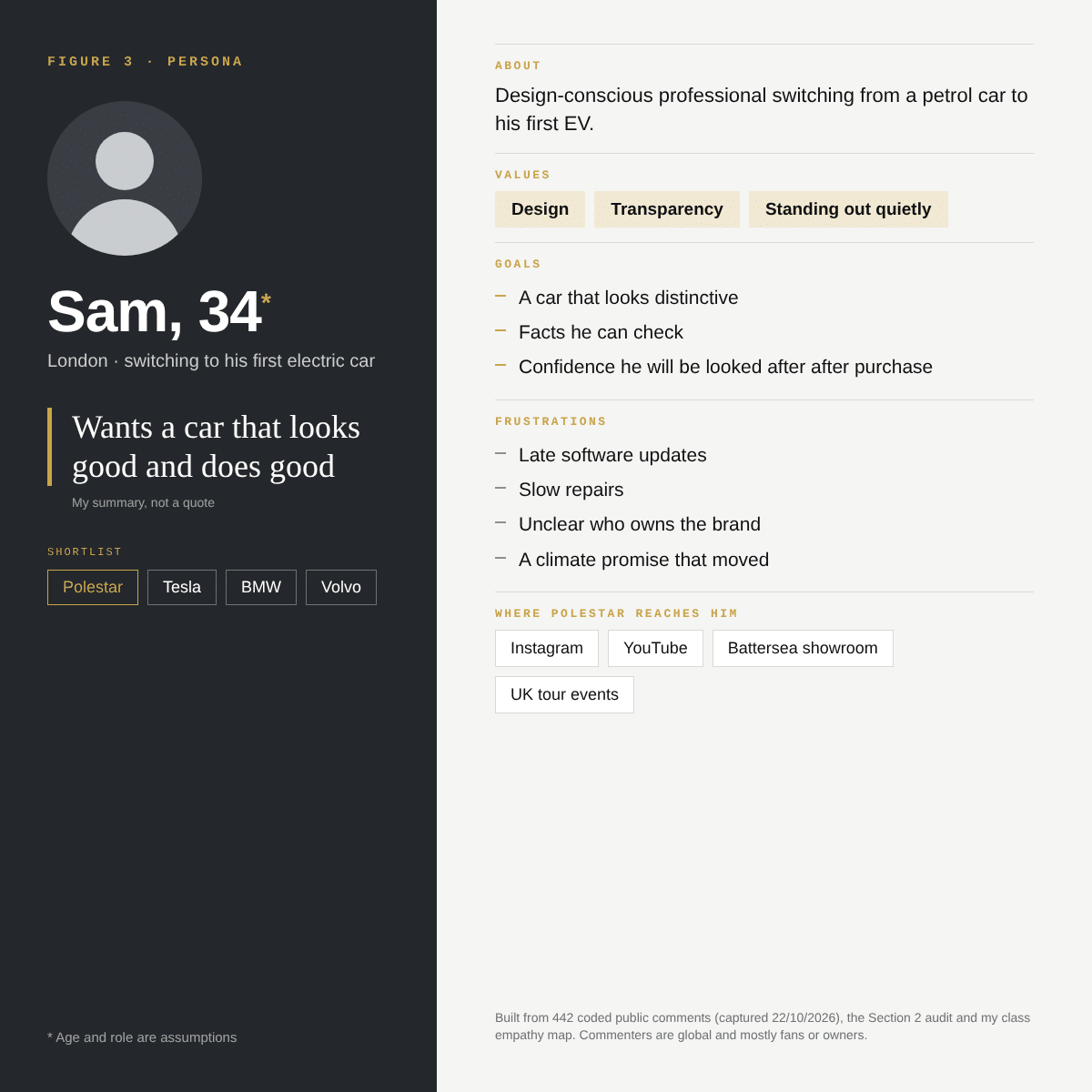
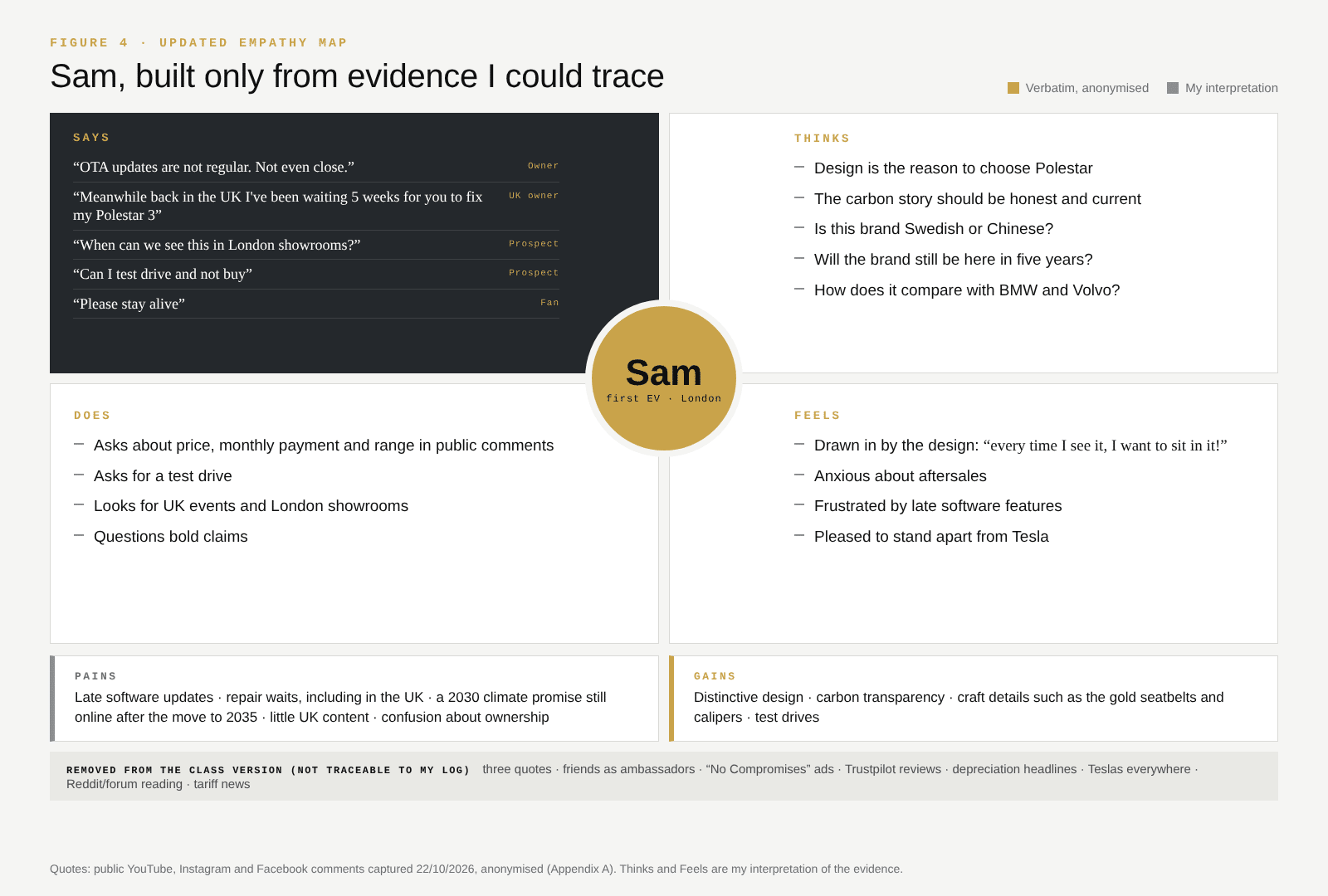
Section 2 contradicts part of my class map. I had Sam seeing cinematic social content, yet only six of 39 sampled Facebook posts were UK-specific. I removed every quote and claim I could not trace to my log (Figure 4). My showroom visit was observation only. Battersea was quiet, but its material table and gold details told a craft story Sam rarely sees online.
Comments such as “so Chinese” reduce the brand to a single story (Adichie, 2009), and a purely Scandinavian design story would be another. Polestar is headquartered in Gothenburg in tight collaboration with Volvo Cars in the area of aftersales (Polestar Automotive Holding UK PLC, 2024). At that time, companies controlled by the CEO of Geely controlled many Polestar’s shares (Randall, 2025). Meyer’s (2014, as cited in Coventry University London, n.d.-b) task-based trust is for complaints about delivered tasks, so warmth is not enough to repair the trust. The UK scores a low 35 on uncertainty avoidance (The Culture Factor Group, n.d.), so novelty may worry Sam less than delivery. His age is my assumption, and most commenters are global fans or owners.
Insight and opportunity. Polestar can tell the full story of owning one in the UK, because Sam values design and transparency but struggles to trust a young brand on service and revised claims. “The Full Story” can open with my own footage of the craft, then give him real owner comments and facts to check.
Section 4: Digital Storyboard & Original Content
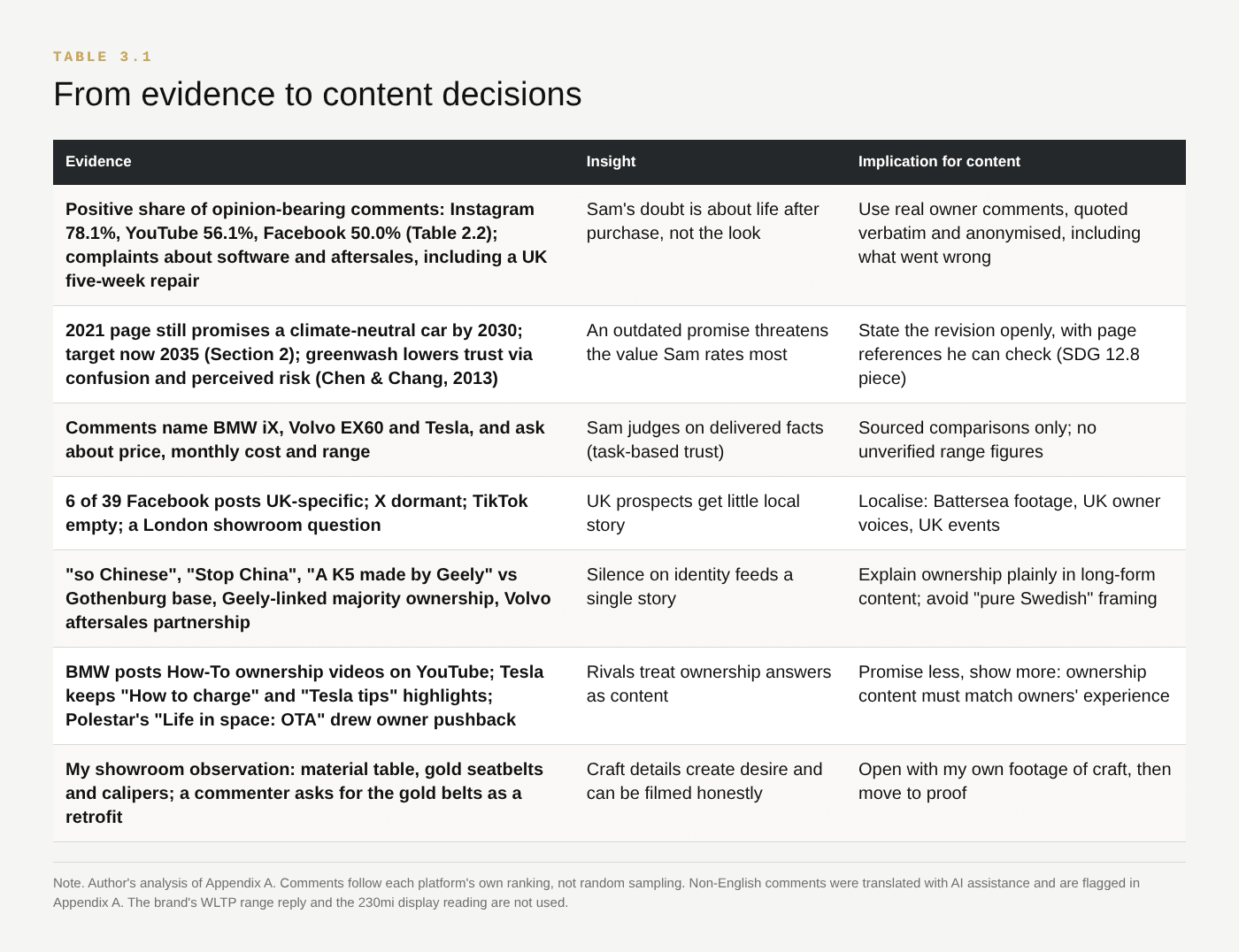
Concept and story arc. “The Full Story” responds to the gap my audit found between Polestar’s design story and the questions buyers bring to it (Section 2). It serves Polestar’s strategy by telling the story of a brand “determined to improve the society we live in” (Polestar, n.d.-a), keeping design as the differentiator in “fast-growing, high-value segments” (Polestar Automotive Holding UK PLC, 2026a, Guidance section) and ending at a test-drive booking. I built the campaign as a sequence of question, answer, proof and next step, and each piece moves Sam one RACE stage forward (Chaffey, 2025). The video opens on craft to win fast, intuitive attention, then hands over to material he can check slowly (Kahneman, 2011). Hamelin et al. (2020) found that affective stories shift attitudes faster while cognitive ones are retained longer, so I put the affective material first and placed the cognitive material in formats that can hold it. The pieces share one spine. The video sends viewers to the blog, and the email repeats the same range figure and source, so a fact checked in one place matches the others.
My class plan relied on filming an owner’s first year. I had no owner to film, and inventing one would break the trust the campaign is meant to build. I rebuilt the opening piece around my own visit and the question the Battersea staff member said customers ask most (Appendix A).
All three pieces share one visual system: my own showroom images, a muted cool grade, one sans-serif typeface and a single gold accent sampled from the calipers. The gold links the craft hook to the buttons that ask for action, so the detail Sam notices first becomes his cue to act. My footage is the campaign’s main point of difference, and a generated image would undercut the claim that I was there.
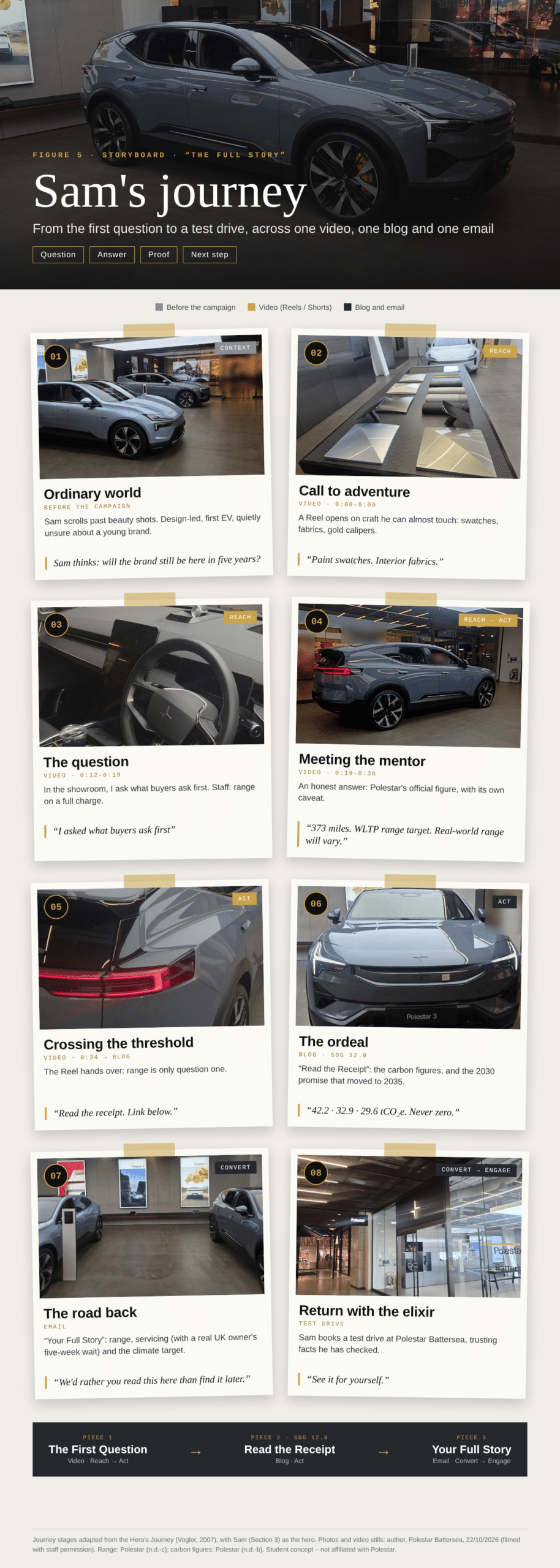
Piece 1: “The First Question” (vertical video, Figure 6).
Objective: stop a design-led prospect, then give him the figure he looks for first.
Strategic rationale: My footage of the material table and the gold calipers makes up the hook. Range material is provided, with Polestar’s own ‘Life in space: Range’ film (Appendix A), and a warning about a ‘sea of sameness’ in AI-generated content from W5 (Coventry University London, n.d.-a). The hand-held footage of a showroom in London is uncopyable; it builds on the light content in Section 2, the UK’s ‘thin’ content, from Polestar’s own ‘Is it? Yes. device keeps the voice on-brand. The figure is Polestar’s WLTP range target for the Polestar 3 Performance, 373 miles, with the page’s caveat that real-world range varies (Polestar, n.d.-c). I chose this version because the showroom price stand confirmed it was the car I filmed (Appendix A), and its figure is the lowest of the three. I excluded the 230-mile dashboard reading because it is not a published figure. Range anxiety is debated. Kershaw et al. (2018) found that anxiety diminishes with experience, though Noel et al. (2019) see range anxiety as a rhetorical device against change. Both readings favour a calm, sourced answer and an invitation to try the car over reassurance alone.
RACE stage: Reach, moving to Act.
Piece 2: “Read the Receipt” (blog, Figure 7), linked to SDG 12.8.
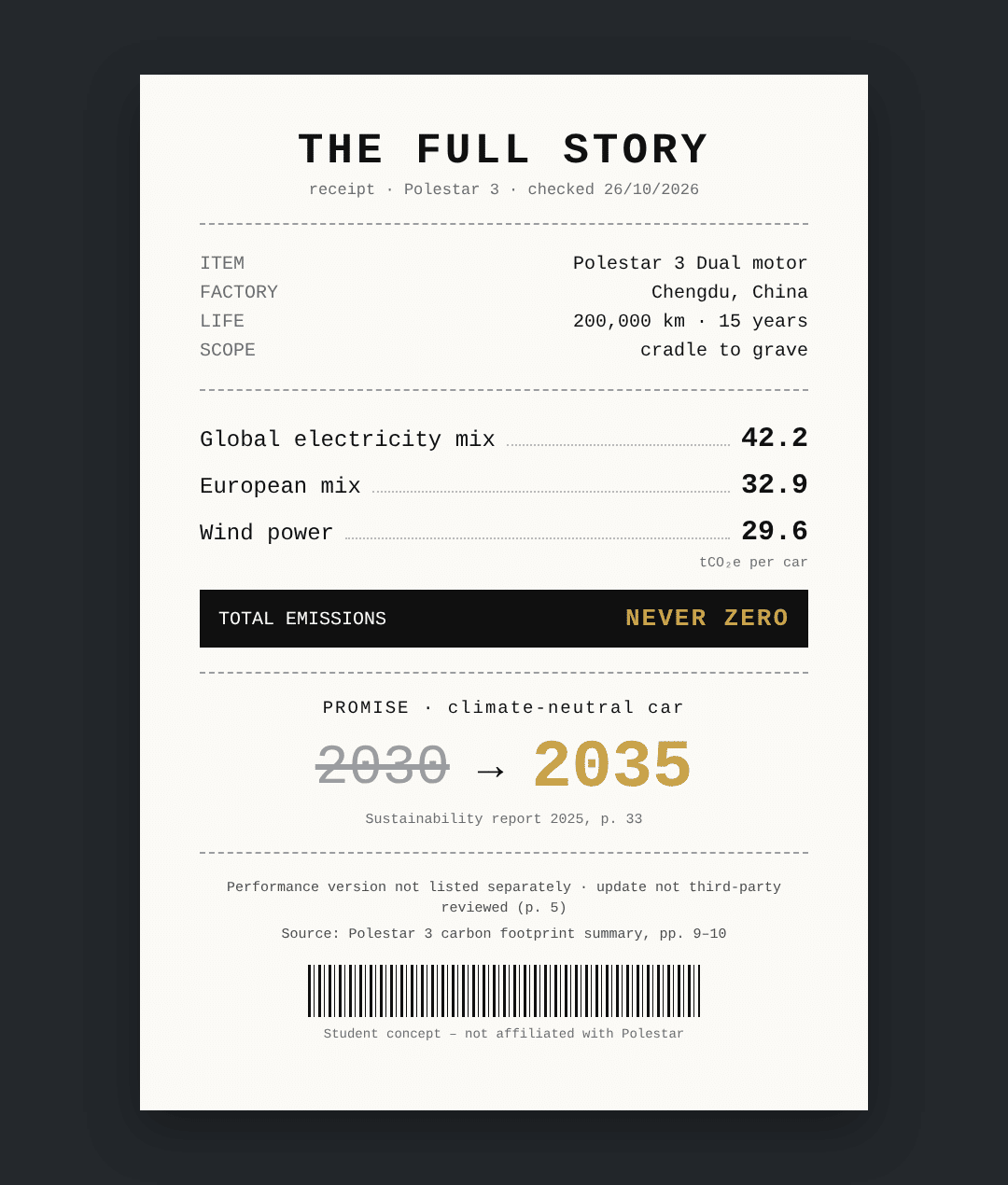
Objective: give readers Polestar’s carbon figures and the revised target in one place, with page references.
Strategic rationale: SDG target 12.8 asks that people everywhere have “the relevant information and awareness for sustainable development” (United Nations, n.d.). The link is real but partial, because its indicator measures education policy, so a brand blog serves the target’s aim, not its measurement. The blog states the revision openly. The 2021 plan aimed for a climate-neutral car by 2030 (Polestar, 2021), and the 2025 report moves that target to 2035 (Polestar Automotive Holding UK PLC, 2026b, p. 33). Chen and Chang (2013) show that greenwash lowers green trust partly through confusion and perceived risk, and an unexplained moved target invites both. Hernandez et al. (2023) found that two-sided advertising raised credibility and purchase intention among highly sceptical consumers without reducing trust among others, and Sam fits that sceptical profile (Section 3). The blog uses whole-life-cycle figures and avoids “zero emission” language, in line with UK guidance (Committee of Advertising Practice, 2024; Competition and Markets Authority, 2021). Openness may read as weakness. I accept that risk, because the 2030 promise is still public and a reader who finds it alone may feel misled.
RACE stage: Act.
Piece 3: “Your Full Story” (email, Figure 8).
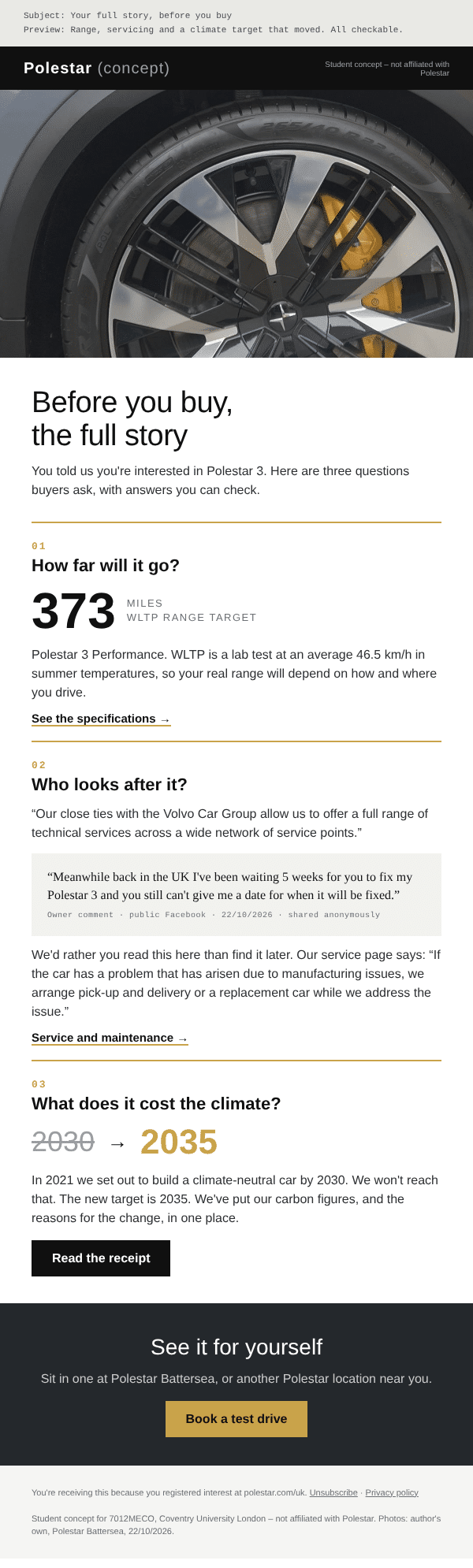
Objective: turn registered interest into a test-drive booking.
Strategic rationale: The email answers three questions before purchase. It repeats the range figure, explains servicing through Polestar’s ties with Volvo Car Group (Polestar, n.d.-d) and links to the blog. Under the servicing answer sits one anonymised owner comment about a five-week UK repair wait. Including this critical comment is deliberate. Section 3 showed that Sam’s doubt concerns life after purchase, and Hollebeek and Macky (2019) place trust before sales in content marketing. Hiding a complaint Sam can already read under Polestar’s posts would cost more trust than it saves.
RACE stage: Convert, then Engage.
Channels and audience fit. Reels and Shorts carry the video because Polestar’s audience sits mainly on Instagram and YouTube (Section 2), and Sam meets the brand on his phone. I left out X and TikTok. Reviving a dormant account for one campaign would look opportunistic, and I have no evidence that Sam researches cars on TikTok. The blog lives on an owned site so every figure links to its source.
Ethics and inclusivity. I tested each piece against the TARES test (Baker & Martinson, 2001; Appendix D). Truthfulness drives the main choices: one named version, one official figure with its caveat, and the revised target in the blog’s opening section. For authenticity, every piece carries “Student concept – not affiliated with Polestar”. Owner voices appear only as public comments, quoted verbatim, anonymised and labelled with platform and date. I rejected composite “customers” because a composite is an invention. Commenters did not agree to appear in a campaign, so I removed names and kept quotes short. For accessibility, the video has burned-in captions and a transcript, images carry alt text, and the email works in plain text. Blurring passers-by protects people who did not agree to be filmed.
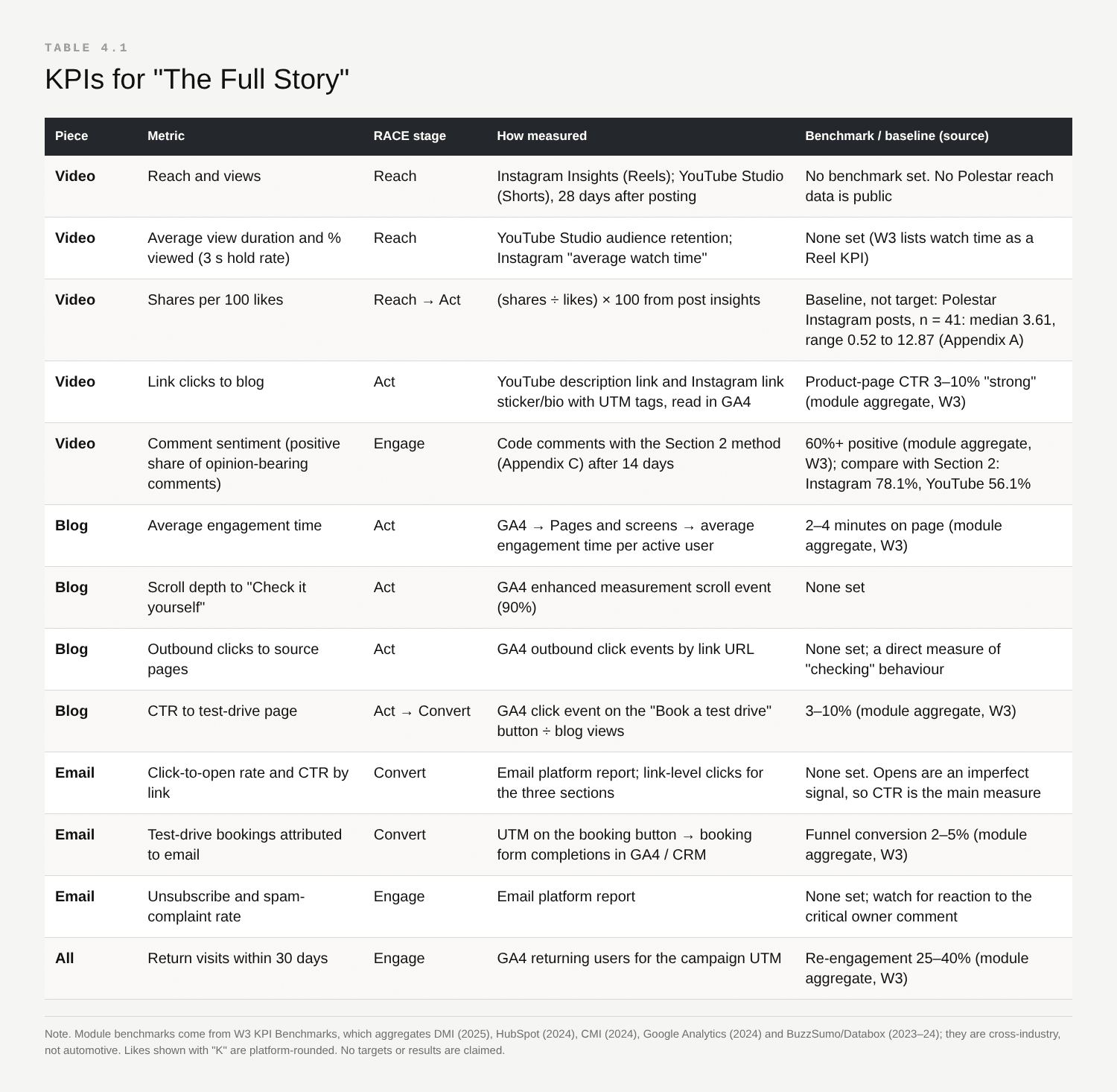
Measurement. Table 4.1 sets out each KPI, its RACE stage and its data source. I set no numerical targets because I have no Polestar baseline for reach, clicks or bookings. Module reference points, such as 60% positive sentiment or two to four minutes on page (Coventry University London, n.d.-c), serve as comparisons only, since they aggregate cross-industry sources. Video comment sentiment can be compared directly with my Section 2 baseline, which makes it the clearest early test of whether openness builds trust. Bookings also respond to price offers and season, so I would read the KPIs together rather than credit any single result to the campaign’s honesty.